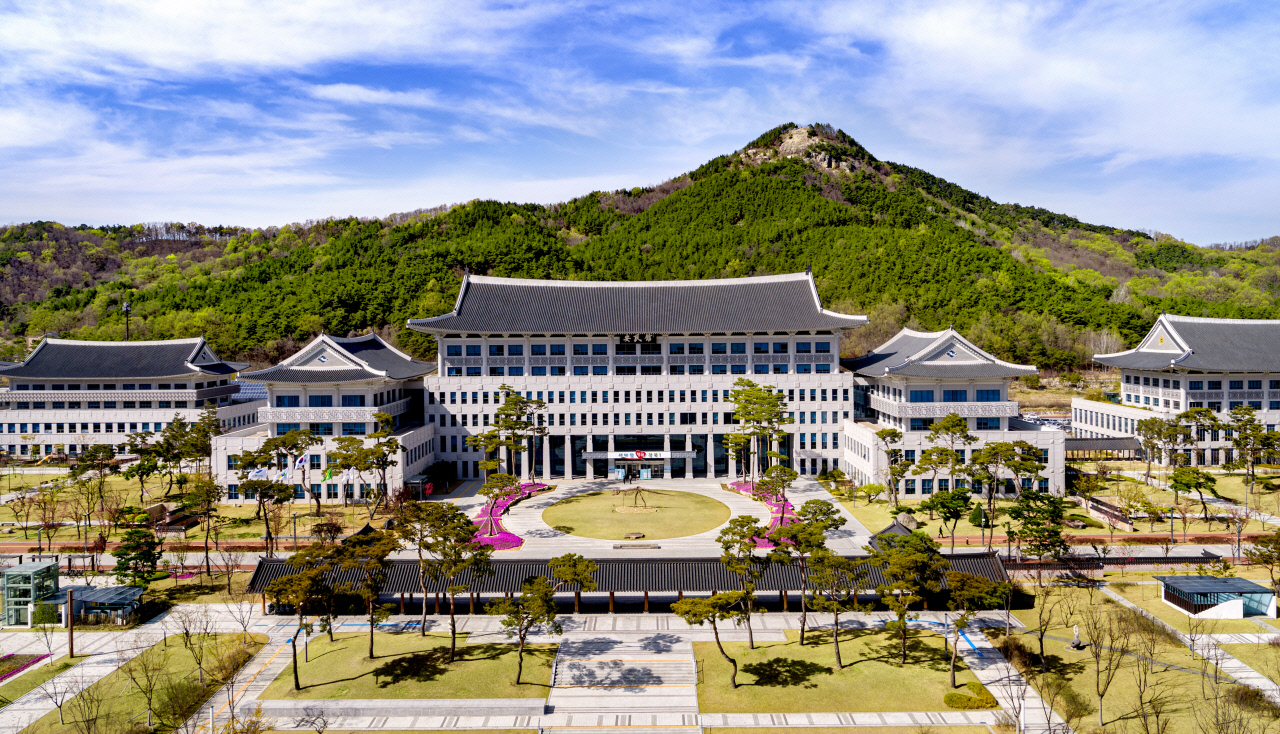
The Gyeongsangbuk-do provincial government has unveiled next year’s 14,036.3 billion won budget plan, focusing on investments in five core areas by capitalizing on the successful hosting of the APEC 2025 Korea.
The provincial government said on Nov. 13 it submitted to the provincial council a revenue/expenditure budget of 14,036.3 billion won for fiscal year 2026.
The next year’s budget plan represents a rise of 5.8 percent or 774.5 billion won over the 2025 budget. It also represents an increase of 5.4 percent or 632.8 billion won in general accounting and a surge of 9.2 percent or 141.7 billion won in special accounting.
A diagram of Gyeongsangbuk-do budget plan for the year 2026. (Source: Gyeongsangbuk-do)
The provincial government finalized the whole budget plan based on a prediction that its own revenues, including provincial tax and non-tax revenues, will decline 4.1 percent, but transfer revenues will increase 7.8 percent by proactively securing national fiscal budget allotments and closely cooperating with the government.
The sagging real estate business and domestic recession are expected to bring about hard fiscal conditions, but the provincial government plans to concentrate investments on the province’s major core tasks, reinvigorate the civilian economy for the interest of provincial residents and create future growth engines that will drive dynamic growth while maintaining a sound fiscal mode.
The priority investment areas of the 2026 budget plan were: stabilizing the public’s livelihoods;, spreading the paradigm shift in the agriculture, forest, ocean sectors; the low-birth rate;, hallyu (Korean Wave); and projects to ramp up “warm welfare” and safety.
Gyeongsangbuk-do made efforts to ensure fiscal soundness and efficiency.
In order to restore sagging commercial districts, Gyeongsangbuk-do plans to set aside 4 billion to support small businesses, 5.9 billion won to implement projects to reinvigorate commercial districts, and 39.5 billion won in support for the issuance of regional gift certificates.
To back up the Special Act on Damage, Caused by Large-Sized Bush Fires, the provincial government allotted 300 million won to designate and operate forest management special zones, 14.8 billion won to restore forest ecosystems damaged by bush fires, and 23.4 billion won for reforestation after bush fires.
To expand the marine economic belt around core centers, such as Yeongil Bay, the provincial government earmarked 900 million won to attract freight to Yeongil Bay in Pohang and 400 million own in support for marine companies’ technology development and commercialization.
To combat the low birth rate, Gyeongsangbuk-do appropriated 8.4 billion won to implement the K-bodeum (care), a public joint child care system, 1.2 billion won in assistance fees of children’s houses for foreigners, and 800 million in support for bigger houses for multi-child families.
In order to implement balanced policies regarding gender, the provincial government set aside 1 billion won in support for youth employees, 600 million won for operating convenience stores for job creation, and 800 million won to operate a “provincial residents’ happiness college.”
To commemorate the successful hosting of the APEC 2025 Korea, the provincial government allotted 2.5 billion won to build an APEC summit memorial, 500 million won to crate the post-APEC “media wall” and 400 million won in special projects to attract foreign tourists to the area where APEC 2025 Korea was held.
Gyeongsangbuk-do Gov. Lee Cheol-woo said, “Gyeongsangbuk-do was set up wisely, overcoming a big crisis caused by bush fires, and the successful hosting of the APEC event, as milestones to make the province known to the world., We will do our utmost to push for pump-priming to ease the public’s hardships related to their livelihoods, breathe new life into the regional economy and the future generation’s dreams.”

























_이철우 도지사.jpg)
_든든한 경북시대 예산.jpg)